
The operator defines permitted parking behavior.
Approved destinations, timing, maximum stay, zones, and other property conditions are configured before monitoring begins.

Keep parking free for legitimate customers without requiring every visitor to pay or register first. VERITAS evaluates the complete parking event against the rules selected for your property.
Walk-Off Monitoring is designed for properties that want customer-only or destination-linked parking without charging every legitimate visitor. The relevant question is whether at least one vehicle occupant has a permitted connection with an approved destination during the complete parking event.
A person walking away immediately after parking does not automatically create a violation. The property operator decides what is permitted—for example, whether an approved destination must be visited immediately, at any time during the stay, or within a configured maximum parking period.
A potential walk-off is an observation, not an automatic decision. Every documented event is measured against the property's configured rules before a case can proceed.
Approved destinations, timing, maximum stay, zones, and other property conditions are configured before monitoring begins.
VERITAS looks for a permitted movement connection between any vehicle occupant and an approved destination during the relevant parking period.
No case action is taken.
A trained reviewer evaluates the context. A private parking invoice proceeds only when the case is supported and confirmed.
Dedicated LPR cameras capture the license plate and a vehicle snapshot as the vehicle enters the property.
Overview cameras document movement during the relevant parking period—not only the first direction a person walks after arrival.
A trained reviewer evaluates whether any vehicle occupant can be connected with an approved destination under the property’s configured rules within 24 to 48 hours.
Only supported cases move into the approved external workflow for a privately issued parking invoice and neutral appeal process.
VERITAS does not need to determine a person's name or identity to evaluate a parking event. The review focuses on whether an observable movement connection exists between any occupant of the vehicle and an approved destination under the property's individual rules.
Facial recognition and biometric identity matching are not used to determine parking compliance. Camera and event information is handled for the documented parking, evidence, safety, dispute, and legal purposes described in the VERITAS Privacy Policy.
Read the Privacy Policy →Dedicated cameras at the entry and exit read license plates and capture vehicle snapshots. Wider overview cameras—including project-specific 180-degree or 360-degree coverage—document movement across the parking area.
A local edge computer connects through a dedicated cellular modem and SIM. The system does not require access to the property's corporate Wi-Fi or local network.
Configure one storefront, several approved businesses, a residential entrance, or another clearly defined zone.
Customers can use the property under its approved rules without starting a paid parking session simply to visit the intended destination.
Recorded events are evaluated by people—not advanced solely by an automated flag or a single isolated image.
VERITAS handles monitoring and structured case review, so property teams do not need to patrol the lot, document vehicles, or place notices themselves.
Potential rule violations can remain documented even when a vehicle leaves before a tow operator could arrive. Towing remains separate where legally required or appropriate.
The primary objective is protecting parking for customers and authorized users, with 10% of gross payments actually collected returned on eligible cases.
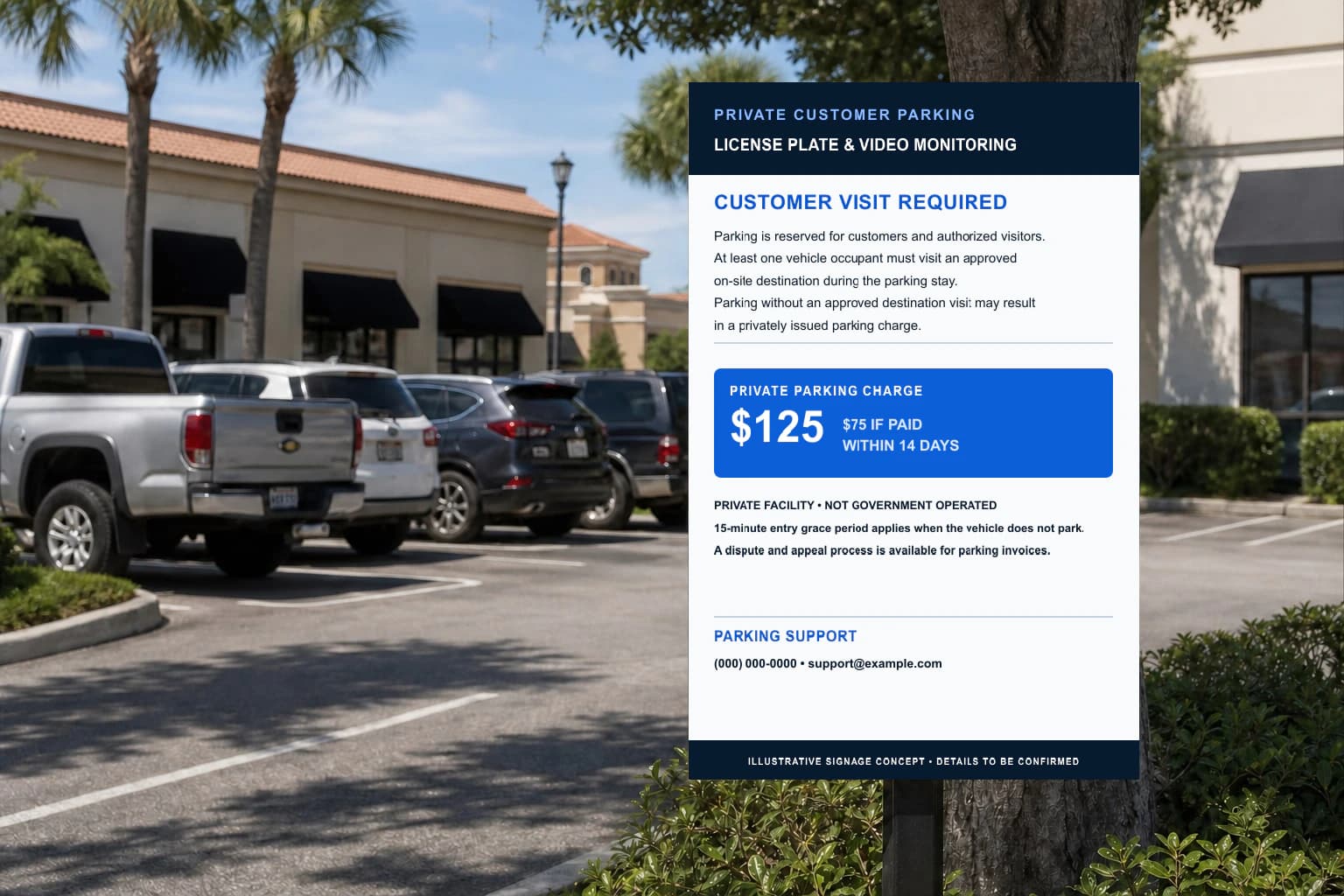
VERITAS plans high-visibility entrance signage around the property's approved destinations and parking conditions. The Walk-Off concept explains that parking is reserved for customers and authorized visitors, that license plate and video monitoring are in use, and that a private parking charge may apply when the documented parking event does not meet the property's posted rules.
The displayed concept uses the current $125 private parking charge and the reduction to $75 when paid within 14 days. Final wording, support information, placement, dimensions, and local requirements are confirmed for each property before production.
Illustrative concept only. The support details shown are placeholders and the final sign requires property-specific approval.When vandalism, theft, property damage, or another incident occurs within the monitored field of view, available footage may provide useful documentation. Relevant material can be preserved separately for an appropriate incident-review or law-enforcement process.
Walk-Off Monitoring is not a live alarm, guarding, or emergency-response service. Routine footage is retained only for the limited period required for operational review; relevant event evidence may be preserved separately when required.
System planning, camera hardware, cellular connectivity, installation, required signage, routine maintenance, and technical calibration are provided without upfront capital expense to the property.